Compare Technical Diving Plans: The Definitive 2026 Editorial Guide
The boundary between recreational exploration and technical diving is not defined merely by depth, but by the imposition of a mandatory physical or physiological ceiling. In the recreational realm, a diver can typically perform a direct ascent to the surface in the event of an emergency. In technical diving, that “up” option is removed, replaced by a series of decompression obligations or physical overheads, such as cave ceilings or shipwreck structures. To manage this transition safely, a diver must move beyond basic survival skills toward a disciplined architecture of decompression theory and gas management.
When an individual begins to compare technical diving plans, they are essentially evaluating different methodologies for managing life-support in environments where the margin for error is effectively zero. These plans are not just schedules for a single dive; they are holistic systems that dictate equipment configuration, gas logistics, and team protocols. The selection of a specific technical training pathway—whether it be through a traditionally structured agency or a more holistic, team-oriented organization—determines how a diver will interpret the physics of the abyss for the rest of their career.
This article provides a rigorous, analytical framework for understanding the systemic differences between various technical diving philosophies. We will move past the superficial branding of various training agencies to look at the underlying mathematical and pedagogical structures. The objective is to equip the serious diver with the mental models necessary to assess risk, calculate resource requirements, and adapt to the evolving standards of deep-water and overhead-environment exploration.
Understanding “compare technical diving plans”
To effectively compare technical diving plans, one must first acknowledge that a “plan” is a living document, not a static table of numbers. Many prospective technical divers mistakenly believe that planning is simply a matter of entering depth and time into a decompression software package. This reductionism ignores the “human factor” and the “equipment factor” that can render a perfectly calculated decompression schedule useless. A robust technical plan accounts for “worst-case” scenarios, including gas loss, team separation, and equipment failure, providing a decision-tree rather than a linear path.
There is a significant misunderstanding regarding the role of “standardized” versus “customized” planning. Some agencies advocate for a highly standardized approach—using the same gas mixtures and equipment configurations regardless of the specific dive—to minimize the potential for human error. Others prioritize flexibility, teaching the diver to build a plan from the ground up based on the specific constraints of the environment. Neither is universally superior; the “best” plan is the one that aligns with the diver’s mission profile and their team’s operational capabilities.
Oversimplification in technical diving is often fatal. When comparing plans, divers frequently overlook the “logistical footprint” of their choice. A plan that requires multiple high-pressure cylinders of helium and oxygen may be feasible in a well-supported dive center in Florida, but completely impractical for a remote expedition in the South Pacific. Therefore, the planning process must include an assessment of resource availability and the “support-to-bottom-time” ratio.
The Historical and Systemic Evolution of Technical Diving
Technical diving as we know it today emerged in the late 1980s as a “rebellion” against the limits imposed by recreational agencies. Early pioneers like Bill Main and Bill Hogarth developed the “Hogarthian” configuration—a minimalist approach to gear designed to reduce drag and snag points in cave systems. This was later institutionalized by organizations like Global Underwater Explorers (GUE), who introduced the concept of “Standard Gases” and a team-centric approach to exploration.
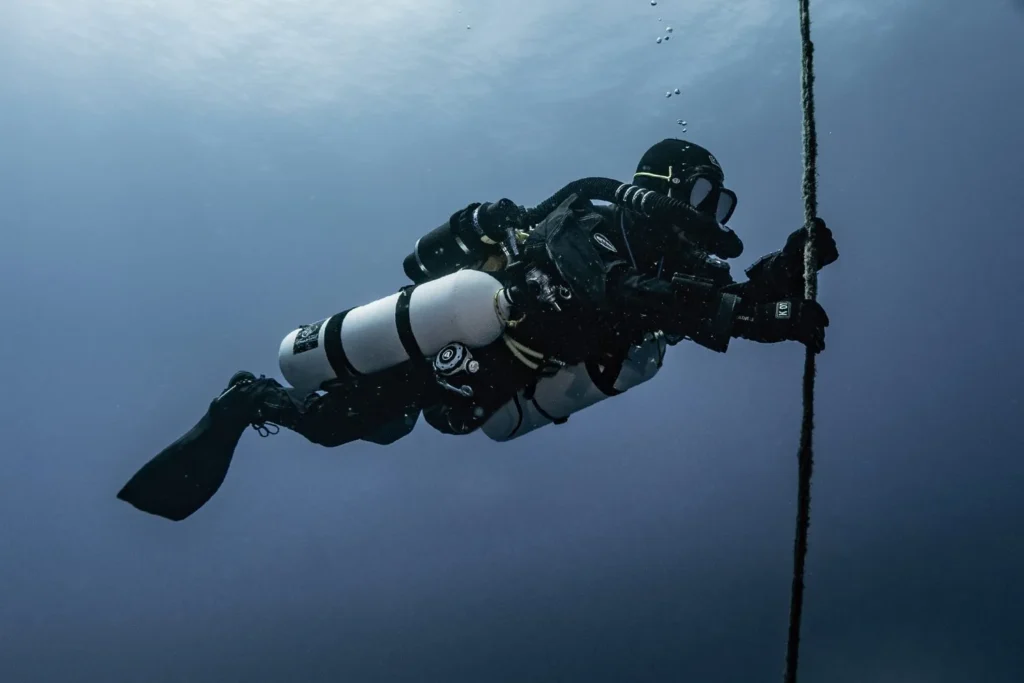
Simultaneously, agencies like IANTD and TDI focused on the pedagogical democratization of technical diving, providing modular training that allowed divers to incrementally increase their depth and decompression limits. The introduction of the Closed-Circuit Rebreather (CCR) in the late 1990s revolutionized the field again, essentially removing the “gas volume” constraint and replacing it with “scrubber duration” and “oxygen sensor” management. Today, the industry is in a state of convergence, where the benefits of standardized team protocols are being integrated into even the most flexible modular training programs.
Conceptual Frameworks and Mental Models
To analyze technical diving systems, one must apply specific mental models that go beyond simple skill acquisition.
1. The “Rule of Thirds” vs. “Rock Bottom”
Traditional gas management often uses the Rule of Thirds: one-third for the way in, one-third for the way out, and one-third for emergencies. In technical diving, this is often replaced by “Rock Bottom” or “Minimum Gas” planning. This model calculates the exact amount of gas required for two divers to perform a safe ascent from the deepest point of the dive, including decompression stops, in the event of a total gas failure for one diver.
2. The Task Loading Buffer
Technical diving inherently increases task loading. A diver must manage buoyancy, navigation, gas switching, and decompression schedules simultaneously. A well-constructed plan includes “buffers”—periods of low activity during the dive—to allow the diver to reset their mental state and check for “drift” in their execution.
3. The “Team as a Single Organism” Model
In technical diving, the team is the unit of survival. If one diver has a problem, it is the team’s problem. This model dictates that all team members must have identical gas mixtures, identical decompression schedules, and compatible equipment. If you compare technical diving plans and find a discrepancy in these areas, the plan is fundamentally flawed from a safety perspective.
Key Categories or Variations
Technical diving is generally divided into several specialized disciplines, each with its own set of planning priorities.
| Discipline | Focus | Primary Constraint | Planning Priority |
| Advanced Nitrox/Deco | Entry-level technical | Gas volume; oxygen toxicity | Switch-point accuracy |
| Trimix (Open Circuit) | Deep water (40m – 100m+) | Helium cost; narcosis management | Narcotic depth control |
| CCR (Rebreather) | Extended duration/depth | Scrubber life; electronics failure | Bailout logistics |
| Cave Diving | Overhead environments | Physical ceiling; silting | Navigation and gas reserves |
| Advanced Wreck | Structural overheads | Entanglement; collapse risk | Penetration depth/line work |
Decision Logic: Rebreather vs. Open Circuit
When you compare technical diving plans for a 60-meter (200-foot) dive, the logic often centers on the “Logistical Cross-over Point.” Open circuit is simpler but requires massive amounts of expensive helium. CCR is more complex and has a higher initial cost, but uses a fraction of the gas. The decision usually rests on the frequency of the dives and the remoteness of the location.
Detailed Real-World Scenarios
Scenario 1: The “Deep Air” Trap
A diver plans a 50-meter dive using air.
-
The Constraint: Nitrogen narcosis and high oxygen partial pressure ($PO_2$).
-
Failure Mode: A minor equipment problem at depth becomes unmanageable due to “narcosis-induced slow thinking.”
-
The Technical Alternative: A Trimix plan that replaces some nitrogen with helium to maintain a “Equivalent Narcotic Depth” of 30 meters.
Scenario 2: Lost Decompression Gas
A diver at 21 meters is ready to switch to 50% Oxygen but the regulator fails.
-
The Constraint: The diver’s remaining bottom gas is insufficient to complete the mandatory decompression stops.
-
The Plan Requirement: The plan must include a “lost gas” schedule, showing how to decompress using the remaining bottom gas, which will significantly extend the time in the water.
Planning, Cost, and Resource Dynamics
The “price” of a technical dive is measured in more than just currency; it is measured in the “Logistical Footprint.”
| Expense / Resource | Estimated Cost | Nuance |
| Helium (Trimix Fill) | $100 – $400 per dive | Highly variable based on global helium supply. |
| Oxygen (Deco Fill) | $20 – $50 per fill | Requires specialized “oxygen clean” cylinders. |
| Sofnolime (CCR Scrubber) | $15 – $30 per dive | Must be monitored for “CO2 breakthrough.” |
| Training (Per Level) | $800 – $2,500 | Includes tuition, boat fees, and gases. |
Risk Landscape and Failure Modes: A Taxonomy
Failure in technical diving is rarely the result of a single event. It is usually a “cascading failure” or an “error chain.”
-
Normalization of Deviance: Skipping a small part of the pre-dive checklist because “it’s always been fine before.”
-
O2 Toxicity: Exceeding the $PO_2$ limits (usually 1.4 at depth and 1.6 during decompression) can lead to underwater seizures.
-
Isobaric Counter-Diffusion (ICD): A rare but serious risk when switching gases (e.g., from a helium-heavy mix to a nitrogen-heavy mix) that can cause inner ear DCS.
Governance, Maintenance, and Long-Term Adaptation
A technical diver’s skills are “perishable.”
-
The 30-Day Rule: If you haven’t performed a technical dive or skill circuit in 30 days, your next dive should be a “work-up” dive at a shallower depth.
-
Review Cycles: After every major expedition, the team should perform a “Debrief” to identify “Near Misses”—events that didn’t cause an accident but had the potential to do so.
-
Adaptation Triggers: A change in equipment (e.g., moving from back-mounted to side-mounted cylinders) requires a complete retraining of all emergency procedures.
Common Misconceptions and Myths
-
“Technical divers are daredevils.” In reality, the best technical divers are the most conservative and risk-averse individuals in the sport.
-
“Computers do the planning for you.” A computer is a secondary tool. A technical diver must be able to calculate their own decompression and gas requirements using a slate and a watch if the electronics fail.
-
“You need to be an athlete to tech dive.” While fitness is important for gas loading and decompression, the most important “muscle” is the brain. Calmness under pressure is the primary requirement.
Conclusion
The ability to compare technical diving plans is the hallmark of a mature diver. It represents a shift from being a “tourist” in the underwater world to being a “technician.” The choice of a plan is not just about the depth of the wreck or the length of the cave; it is about the integrity of the system you bring with you into that environment.