How to Manage Buoyancy Problem: A Definitive Editorial Guide (2026)
The achievement of neutral buoyancy is often described as the “holy grail” of scuba diving. Yet, this framing suggests a static destination rather than a dynamic, ongoing state of physical awareness. For the novice, buoyancy is a struggle against the medium; for the expert, it is a silent dialogue between lung volume, equipment displacement, and the immutable laws of Archimedes. When this dialogue breaks down, the result is not merely an aesthetic failure of form, but a significant compromise in safety, gas consumption, and environmental preservation.
The systemic complexity of buoyancy control lies in its multi-variable nature. A diver must simultaneously manage the compression of a neoprene exposure suit, the shifting weight of a depleting air cylinder, and the varying density of the water column. A failure to synchronize these elements often manifests as the “seesaw effect”—an exhausting cycle of over-inflation and rapid venting that characterizes the inexperienced underwater journey. To address these challenges, one must look beyond the basic “power inflator” and examine the subtle neurological and physiological cues that dictate stability.
This article serves as a comprehensive editorial analysis for the practitioner seeking to transition from “surviving” the water column to “operating” within it with total autonomy. We will deconstruct the mechanics of displacement, the psychology of “breathing through the problem,” and the technical adjustments required for various equipment configurations. The objective is to provide a flagship resource that treats buoyancy not as a single skill, but as the foundational architecture upon which all other diving competencies are built.
Understanding “how to manage buoyancy problems.em”
In technical and recreational diving circles, the inquiry into how to manage the buoyancy problem is frequently met with the advice to “just add more weight.” This is a fundamental oversimplification that often exacerbates the underlying issue. Over-weighting forces a diver to add more air to their Buoyancy Control Device (BCD) to compensate, creating a large, unstable “bubble” that shifts as the diver changes orientation. This shift in the center of gravity leads to poor trim, increased drag, and a higher probability of silting or reef damage.
A multi-perspective view reveals that buoyancy problems are rarely isolated to the BCD. They are often “symptomatic” failures. For example, an anxious diver will habitually maintain a high lung volume (tidal volume), effectively carrying a permanent “balloon” in their chest. No amount of gear adjustment can solve a buoyancy issue that is rooted in a psychological inability to exhale fully. Understanding the intersection of stress, respiration, and physics is the first step toward a permanent solution.
Oversimplifying the management of buoyancy also risks ignoring the “depth-pressure” relationship. Because air is compressible, a diver’s buoyancy is inherently unstable; as they descend, their suit and BCD air compress, making them “heavier” (less buoyant), which requires adding air. As they ascend, that air expands, making them “lighter” (more buoyant), which requires venting. Managing this problem requires a proactive, rather than reactive, approach—anticipating the expansion before it becomes an uncontrolled lift.
The Physics of Displacement: Historical Context
The fundamental law governing buoyancy was articulated by Archimedes of Syracuse over two millennia ago: any object, wholly or partially immersed in a fluid, is buoyed up by a force equal to the weight of the fluid displaced by the object. In the context of early diving, this was managed through crude heavy-weight boots or lead belts with little regard for the fine-tuning of neutral states.
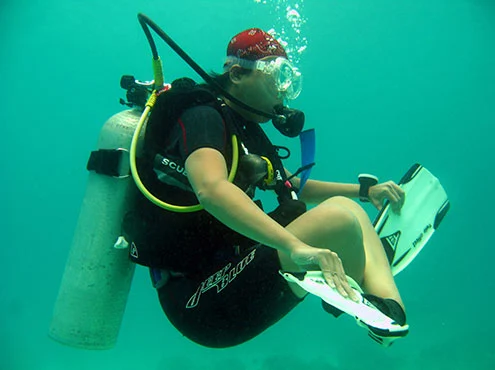
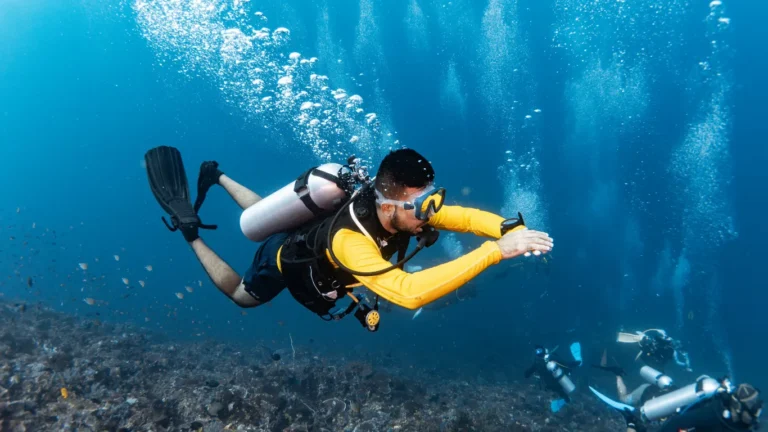
The evolution of modern buoyancy management began with the introduction of the “Stabilizing Jacket” in the late 1960s. Before this, divers often relied on their lungs alone or rudimentary “horse-collar” life vests. The systemic shift toward the modern BCD allowed for the exploration of deeper and more varied environments, but it also introduced a new failure mode: the reliance on mechanical lift at the expense of fundamental breathing technique. Today’s top-tier systems, including back-plate and wing (BP&W) setups, prioritize a “horizontal trim” profile, recognizing that buoyancy and body position are inextricably linked.
Conceptual Frameworks and Mental Models
To achieve mastery, a diver should apply these mental models to every descent:
1. The “Lung as a Fine-Tuner” Model
The BCD should be used to achieve “gross” neutrality—getting the diver close to the mark. The lungs are the “fine-tuning” dial. A diver should be able to move up or down two feet simply by adjusting the depth and duration of their inhalation and exhalation. If you find yourself constantly reaching for the inflator hose, your gross buoyancy is likely set incorrectly.
2. The “Center of Gravity vs. Center of Buoyancy.”
In water, these two points rarely align perfectly. The center of buoyancy is usually in the chest (lungs), while the center of gravity is often in the hips (weight belt). The distance between these two points determines your “trim.” Managing a buoyancy problem often means relocating weights (e.g., to tank straps or trim pockets) to bring these two centers into alignment, preventing the “tail-heavy” posture that causes inefficient kicking.
3. The “Anticipatory Venting” Framework
This model dictates that a diver should vent air from their BCD before starting an ascent. By creating a slightly “heavy” state before moving up, the diver compensates for the inevitable expansion of air that will occur as pressure decreases, maintaining total control throughout the safety stop.
Categories of Buoyancy Variations and Trade-offs
| Configuration | Primary Benefit | Trade-off / Logic |
| Jacket BCD | High vertical lift at surface; intuitive. | Air traps in “pockets” can ppush the iver into a vertical “Seahorse” position. |
| Back-Plate & Wing | Encourages horizontal trim; modular and streamlined. | Less buoyant at the surface; requires a higher skill level to master. |
| Side-Mount | Relocates weight to the sides; great for tight spaces. | Complex hose routing; shifting buoyancy as tanks empty. |
| Drysuit Diving | Thermal protection acts as a secondary BCD. | Adds a “second bubble” to manage the risk of air migrating to the feet. |
Realistic Decision Logic
The choice of equipment should match the “Environmental Demand.” If diving in high-surge, shallow water, a Jacket BCD’s ease of use might be preferable. However, for most divers seeking long-term growth, a BP&W system offers the best structural foundation for managing buoyancy problems because it places the lift (the wing) directly behind the center of gravity (the tank).
Detailed Real-World Scenarios
Scenario 1: The “Ballooning” Safety Stop
A diver reaches the 15-foot mark with 500 PSI in an aluminum tank.
-
The Problem: Aluminum tanks become positively buoyant as they empty.
-
The Solution: The diver must account for this “swing weight” (about 4.4 lbs) during the initial weighting process.
-
Failure Mode: Starting the dive perfectly neutral with a full tank, only to find it impossible to stay down at the end of the dive.
Scenario 2: The Drysuit “Feet-Up” Emergency
Air migrates to a diver’s boots while in a head-down position.
-
The Problem: The lift is now at the feet, making it impossible to reach the exhaust valve on the shoulder.
-
The Mitigation: Tucking the knees to the chest, performing a “back-roll” to move the air back to the torso, and immediately venting.
Planning, Cost, and Resource Dynamics
Refining buoyancy is an investment in both “lead” and “time.”
| Item | Cost Range (USD) | Resource Value |
| Professional Weight Check | $50 – $100 | Saves years of frustration and tank-banging. |
| Trim Pockets/Weights | $30 – $80 | Essential for moving weight off the waist. |
| Peak Performance Course | $150 – $300 | Focused mentorship on breathing and trim. |
| Steel vs. Aluminum Tank | $250 – $500 | Steel tanks stay “heavy” at the end, simplifying buoyancy. |
Risk Landscape and Failure Modes
Buoyancy failure is a “cascading” risk.
-
Uncontrolled Ascent: Rapid expansion of gas in the lungs (over-expansion injury) or the blood (DCS).
-
Environmental Impact: Crushing delicate coral structures or “silting out” a cave or wreck, leading to navigation failure.
-
Task Loading: A diver struggling with buoyancy cannot focus on their air supply, their buddy, or their navigation, leading to a loss of “Situational Awareness.”
Governance and Long-Term Adaptation
Buoyancy is not a “once-and-done” skill. It requires constant monitoring:
-
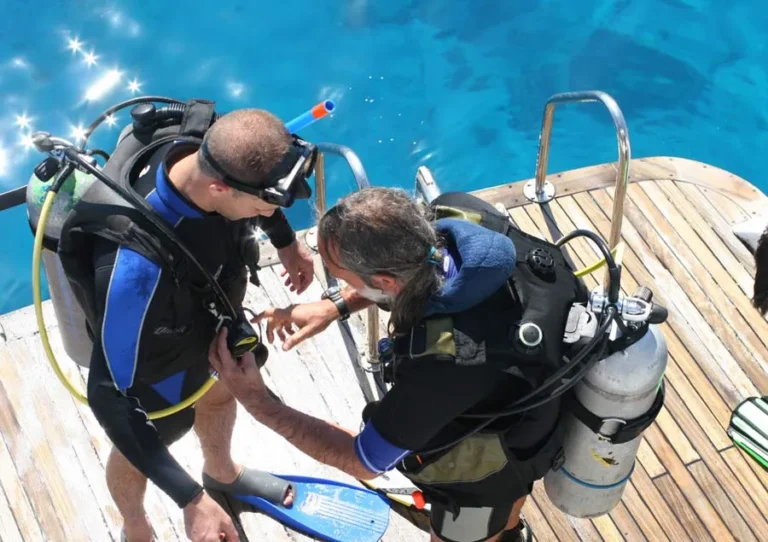
The “Weighting Audit”: Perform a proper weight check at the beginning of every dive trip. Changes in salt density (e.g., Red Sea vs. Caribbean) can require 2–4 lbs of adjustment.
-
The “Empty Tank” Test: The only way to know if you are correctly weighted is to perform a weight check with a tank near 500 PSI.
-
Adjustment Triggers: A change in wetsuit thickness (e.g., from 3mm to 7mm) increases the “compressible volume” of the diver, requiring a complete recalibration of their buoyancy plan.
Common Misconceptions and Oversimplifications
-
“I need more weight because I can’t get down.” Correction: Most beginners can’t get down because they are “fanned” out or finning unconsciously, not because they are too light.
-
“Using the BCD to go up and down is normal.” Correction: The BCD is for depth changes; the lungs are for minute-to-minute movement. Relying solely on the BCD is “reactive diving.”
-
“Weights should always be on a belt.” Correction: A weight belt is often the worst place for weights, as it pulls the hips down, destroying trim. “Integrated weight” or “trim pockets” are usually superior.
Conclusion
Mastering how to manage the buoyancy problem is a journey of internalizing physics into muscle memory. It requires a shift from viewing the ocean as a weightless environment to seeing it as a medium of varying pressures that must be actively managed. By prioritizing correct weighting, horizontal trim, and respiratory discipline, a diver moves from being a guest in the water to a master of their own displacement. The ultimate sign of success is “the hover”—the ability to hang motionless in the water column, suspended by nothing but a perfectly calculated breath.