Common Scuba Gear Mistakes: The Definitive 2026 Editorial Guide
The integration of life-support technology with human physiology in a high-pressure aqueous environment leaves little room for mechanical ambiguity. Scuba diving is, at its core, a hardware-dependent pursuit where the equipment acts as a bridge between terrestrial biology and sub-aquatic survival. While modern engineering has made catastrophic equipment failure exceedingly rare, the manner in which divers select, configure, and maintain their gear remains a primary source of operational friction and safety compromises.
The challenges inherent in gear management often stem from a fundamental misalignment between a diver’s actual needs and the marketing narratives of the dive industry. Many practitioners view their equipment as a collection of isolated tools rather than a singular, integrated system. This compartmentalized thinking leads to “configuration drift,” where incremental additions of accessories and “convenience” items eventually degrade the streamlining and functionality of the entire rig.
Addressing these technical lapses requires an analytical approach that treats equipment as a series of trade-offs. Every clip, hose, and valve added to a diver’s person increases task loading and potential failure points. To master the art of the underwater “kit,” one must move beyond the basic checklists provided in entry-level courses and develop an editorial eye for the nuances of mechanical reliability and ergonomic efficiency.
This article provides a rigorous deconstruction of the errors that plague both novice and veteran divers alike. We will examine the physics of gear failure, the psychology of “Gear Acquisition Syndrome,” and the systemic maintenance lapses that lead to mid-dive emergencies. By treating the dive rig as a critical infrastructure project, we can establish a set of standards that prioritize long-term durability and safety over superficial aesthetic trends.
Understanding “common scuba gear mistakes”
To effectively analyze common scuba gear mistakes, one must distinguish between “active failures” and “latent conditions.” An active failure is a diver forgetting to turn their air all the way on; a latent condition is the purchase of a regulator that is difficult to service in the diver’s home region. Many divers focus exclusively on the former while ignoring the systemic impact of the latter. Oversimplification in this field often leads to a focus on the “what” of gear (the brand, the color, the price) rather than the “how” (the configuration, the routing, and the compatibility).
From a multi-perspective view, a dive shop owner might see a gear mistake as a failure to upgrade, whereas a technical diving instructor might see a gear mistake as the use of an over-complicated jacket BCD instead of a streamlined wing. This tension highlights a core truth: the “best” gear is entirely dependent on the mission profile. A significant misunderstanding involves the “safety-by-complexity” myth—the idea that more features inevitably lead to more safety. In high-pressure environments, simplicity is often the most resilient safety feature.
Furthermore, we must address the “ergonomic mismatch.” Divers often purchase gear that fits well on a dry showroom floor but becomes restrictive or unmanageable under the compression of a 7mm wetsuit at 60 feet. These errors are not just about discomfort; they lead to increased air consumption (SAC rate) and reduced situational awareness. Avoiding these mistakes requires a shift in perspective, viewing the gear as an extension of the body rather than a suit of armor.
Historical Context: The Evolution of Gear Reliability
The history of scuba gear is a transition from “rugged individualism” to “standardized consumerism.” In the early days of the Cousteau-Gagnan regulator, divers had to be amateur mechanics, often building their own backplates and modifying industrial valves. Reliability was high because the users deeply understood the mechanics of their life support.
The 1980s and 90s brought the mass-market “Jacket BCD” and the integrated dive computer, which revolutionized access to the sport but also introduced a generation of divers who viewed gear as “black box” technology. This era gave rise to the “recreational configuration”—a layout designed for ease of sale rather than ease of use in emergencies. The modern era is seeing a return to “DIR” (Doing It Right) philosophies, which advocate for extreme standardization across teams to minimize the potential for human error during equipment-related crises.
Mental Models for Equipment Selection and Configuration
To avoid the pitfalls of poor equipment management, practitioners should utilize these analytical frameworks:
1. The “Failure Points vs. Benefits” Ratio
Every piece of gear added to a configuration must provide a benefit that outweighs its potential as a failure point. A retractable gear keeper for a compass might seem convenient, but if it creates a snag hazard in a wreck or prevents a diver from reaching a chest D-ring, the ratio is negative.
2. The “Muscle Memory” Lockdown
The position of critical items—the secondary air source, the pressure gauge, and the cutting tool—must be standardized. A common mistake is moving these items between dives. In a high-stress “Out of Air” (OOA) situation, the brain reverts to primal movements; if the regulator isn’t where it was yesterday, the results can be fatal.
3. The “Serviceability Radius”
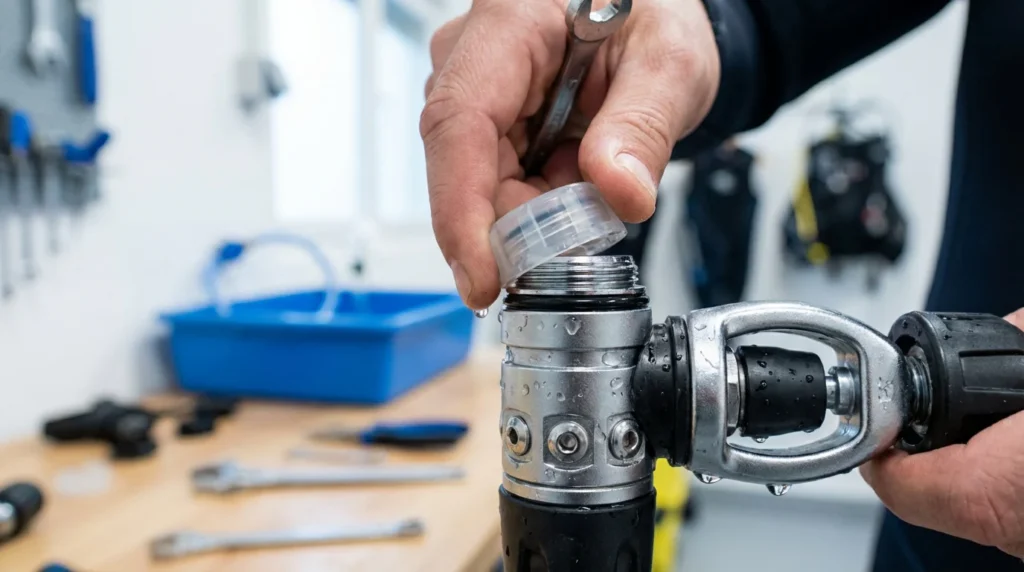
Equipment value is zero if it cannot be maintained. This model dictates that one should only purchase gear for which they have a local, certified service technician. Buying a niche, high-performance regulator from an overseas boutique brand is a strategic error if the annual service requires a six-week shipping turnaround.
Categories of Gear Failures and Systemic Trade-offs
| Component | Common Failure Mode | Trade-off / Logic |
| Mask | Persistent fogging / Poor seal. | Low-volume masks are easier to clear but can feel claustrophobic. |
| Regulator | First-stage “Free flow” in cold water. | Environmental sealing adds cost but prevents icing. |
| BCD | Over-inflation / “Dump valve” failure. | Jacket styles are stable at the surface but bulky underwater. |
| Dive Computer | Battery failure mid-trip / Algorithm mismatch. | Conservative algorithms increase safety but limit bottom time. |
| Fins | Strap breakage / Inefficient blade stiffness. | Split fins reduce leg strain but lack power in currents. |
Decision Logic for Configuration
When selecting a configuration, the logic should prioritize “Access to Information” (the computer and SPG) and “Access to Air.” Any gear that obscures these two pathways is a fundamental configuration error.
Real-World Decision Scenarios
Scenario 1: The “Over-Weighted” Beginner
A diver adds 4 lbs of extra lead to “stay down” at the end of the dive.
-
The Error: This forces the diver to put more air in their BCD at depth, creating a large, shifting air bubble.
-
Failure Mode: Poor trim leads to the “Seahorse” position, doubling air consumption and causing the diver to accidentally kick the reef.
Scenario 2: The “Dangling” Console
A diver lets their pressure gauge and computer console hang freely from their side.
-
The Error: The console drags through the sand or across coral.
-
Failure Mode: The glass becomes scratched and unreadable, or the high-pressure hose snags on a rock, causing a catastrophic gas leak.
The Economics of Maintenance: TCO vs. Acquisition Price
The true cost of scuba gear is found in its maintenance lifecycle, not its purchase price.
| Expense Category | Annual Cost (Est.) | Strategic Impact |
| Regulator Overhaul | $150 – $250 | Ensures “Intermediate Pressure” (IP) stability. |
| BCD Internal Rinse | $0 (Time only) | Prevents salt-crystal buildup in the dump valves. |
| Computer Battery/Service | $50 – $100 | Prevents “Black Screen” events at depth. |
| Hydrostatic Tank Test | $50 (Every 5 yrs) | Required by law for pressure vessel safety. |
The “Grey Market” False Economy
Buying from unauthorized online retailers might save 20% on the acquisition price, but it often voids the “Free Parts for Life” programs offered by manufacturers. Over a ten-year lifespan, a “budget” grey-market purchase can end up costing $1,000 more in service parts than a retail-purchased unit.
Strategic Toolsets and Support Systems
To mitigate common scuba gear mistakes, a diver must maintain a support ecosystem:
-
The “Save-a-Dive” Kit: Not just O-rings, but a spare mask strap, a backup computer battery, and a multi-tool specifically for regulator ports.
-
Vacuum Leak Detectors: For underwater photographers, this is a non-negotiable tool to prevent housing floods.
-
The “Predive” Checklist: Using a formalized, written or verbal checklist (like SEABAG or BWRAF) to catch gear errors before entering the water.
-
Standardized Hose Lengths: Using hoses that are exactly the right length for the configuration to prevent “bowing” and snag hazards.
Risk Taxonomy: Compounding Equipment Risks
Equipment risks rarely occur in isolation. They compound to create “The Accident Chain.”
-
Primary Risk: A small O-ring leak in the secondary regulator.
-
Compounding Factor: The diver is over-weighted and struggling with buoyancy.
-
Failure State: The diver becomes stressed, their breathing rate increases, and the minor leak becomes a panic trigger, leading to an uncontrolled ascent.
Long-Term Governance and Maintenance Adaptation
A professional diver treats their gear with the discipline of an aviator.
-
Monitoring: Keeping a “Gear Log” that tracks the date of the last service and the number of dives on each O-ring.
-
Review Cycles: Every 50 dives, the diver should perform a “Configuration Audit,” removing any piece of gear that has not been used during that period.
-
Adjustment Triggers: If a diver moves from tropical to cold water, they must adapt their regulator and BCD to handle the increased insulation and potential for freezing.
Common Misconceptions
-
“New gear is always better.” Correction: A well-maintained 10-year-old regulator is safer than a brand-new one that hasn’t been “broken in” or tested in a pool.
-
“Fins are just for swimming.” Correction: Fins are your primary propulsion and stability system. Choosing fins based on color rather than “thrust-to-weight” ratio is a major error.
-
“Computers prevent the bends.” Correction: Computers only track a mathematical model. They don’t know if you are dehydrated or cold. Over-reliance on the “No-Deco” screen is a behavioral gear mistake.
Conclusion
Managing common scuba gear mistakes is a process of ongoing refinement. It requires an admission that no equipment is “set and forget.” The most successful divers are those who approach their kit with a mixture of skepticism and meticulous care—skepticism toward unnecessary “innovations” and care toward the life-critical seals and valves that make underwater life possible. By prioritizing streamlining, serviceability, and standardized configurations, a diver ensures that their equipment remains a silent partner in the exploration of the abyss, rather than the protagonist in an underwater emergency.